Solberg
New Build
/
2022
The Brief
The site is on a south-facing slope above Fanafjorden, thirty minutes from Bergen by car. The cabin sits within a stand of mature pine with an uninterrupted view across the water — the kind of position that takes years to find and longer to afford. The Solbergs had inherited it. Their job was not to find the site. It was to build something worthy of it.
Marte and Henrik are in their early forties. No children. Two careers that follow them home. What they needed from a building here was not a retreat from other people but a place to bring them — a house designed around the rhythms of hosting rather than the habits of a couple on their own. Weekends with friends. Summer gatherings. The long table filled. The building had to work as well with ten people in it as with two.
The brief asked for a kitchen that could feed a group without isolating the person cooking. A living space generous enough to hold a gathering without feeling managed. Bedrooms that gave guests quiet and privacy without putting them somewhere separate from the life of the house. And a deck that extended the interior toward the water — not as an afterthought, but as the room the whole building faces.

The Constraints
Building on an inherited waterfront site above Fanafjorden comes with planning constraints that a site purchased for development would not carry. The building footprint, ridge height, and cladding specification were all governed by municipal guidelines designed to preserve the character of established cabin settlements along the fjord. The massing of the building — its gable form, its horizontal cladding profile, its relationship to the treeline — was not freely chosen. It was arrived at within a set of rules that left less room than the brief initially assumed.
The pine stand presented its own constraints. Root protection zones restricted where the foundation could be placed and ruled out a basement or lower-ground level entirely. The building had to sit where the trees allowed it to sit, which turned out to be twelve metres closer to the road than Henrik and Marte had originally imagined. The deck, positioned at the building's south-west corner, became the answer to that displacement — projecting the usable outdoor space out toward the water and the view the building itself could not quite reach.
The site's orientation also meant that the gable end — the face with the most glazing — faces south-west rather than due south, which affected the solar gain calculations for the glazing specification and the specification of the glass itself.

The Approach

The gable form was given to the project by planning. What wasn't given was what happened inside it. The roof pitch was maximised within the permitted envelope, and the ceiling was lined in pale timber rather than plastered, so the interior reads as a continuous warm surface from ridge to eave rather than a volume that happens to have a pitched roof above a flat ceiling. That decision — to line the pitch rather than hide it — is what gives the living space and the bedroom their height and their quality of light.
Glazing on the south-west gable runs from floor to apex, and was sized to bring in winter sun at a low angle while the framing system limits direct summer gain. The same gable window pattern repeats in the bedroom, so the view across the pine canopy to the fjord is present in both the social and private parts of the building, not only in the main living volume.
The cladding is pale-stained horizontal timber, chosen to weather slowly and evenly in a coastal environment with salt exposure from the west. The stain specification was matched to the colour of the interior ceiling lining, so the building reads as a single material from inside to out rather than as a house with an exterior and an interior.
The Work

The kitchen is positioned along the internal wall rather than the glazed gable, so whoever is cooking faces into the room — toward the table, the guests, and the living space — rather than away from it. That placement was the single most consequential plan decision in the brief, and it was resolved in the first design session. Everything else in the open volume arranged itself around it.
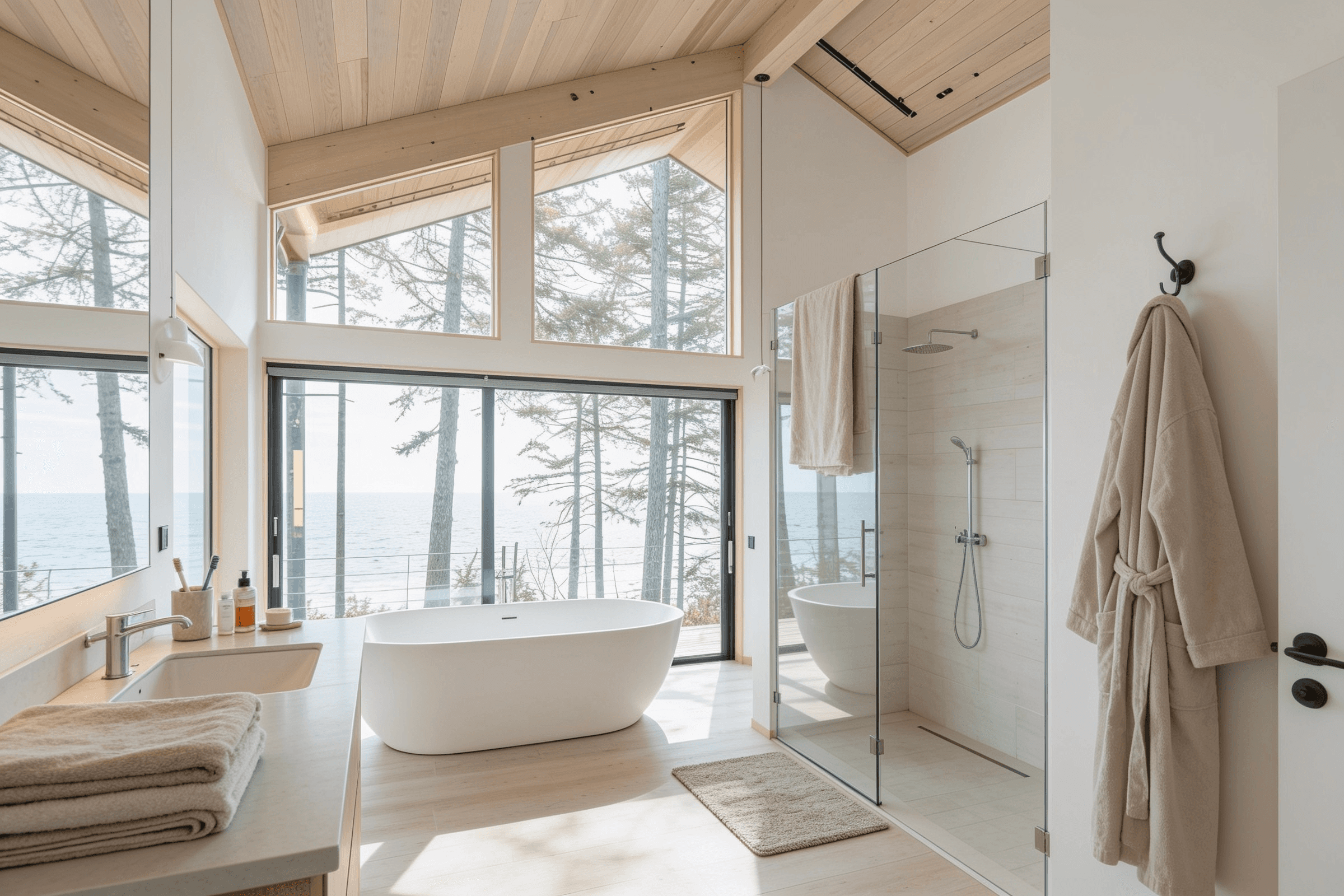
The bathroom carries the full ceiling language of the rest of the building — vaulted, timber-lined, with apex glazing above the bath. The freestanding bath is positioned to face the water through the lower sliding door rather than the upper apex window, so the view is at eye level when lying down rather than overhead. The glazed shower enclosure is positioned so it doesn't interrupt that sightline from the vanity side of the room.
The deck sits on a separate foundation from the house, allowing it to move independently in frost without loading the building's structure. The cable balustrade was specified over a solid glass system for its lower visual weight — less interruption between the deck and the pine trunks beyond it.

The Outcome
The Solberg cabin earns the site. That was the brief, stated plainly in the first conversation and returned to at every point where a decision could have gone the other way. The building is not trying to compete with what's outside it — the pine, the fjord, the quality of the light on a clear Norwegian afternoon. It is organised around those things, positioned to face them, and resolved in a material palette that recedes rather than asserts.
For Marte and Henrik, the test of the building is a practical one. It is whether the house works when it is full — whether there is room to cook for a group, space for everyone to be comfortable, and somewhere quiet to retreat to at the end of an evening. By that measure, it works.
"We had lived with the old cabin for so long we'd stopped seeing what was wrong with it. Sigrid saw it immediately. The building we have now is the one that was always possible — we just needed someone to make the case for it."
Marte and Henrik Solberg
More Projects
Erik and Tone Haugen
Renovation
2022

Erik and Tone Haugen run a restaurant. Erik is the head chef. Tone keeps everything moving. The flat is where the next dish gets tested before it reaches a paying table — and where they host, rest, and start again. The brief was precise: a kitchen built for real work, a home built around it, and nothing that got in the way of either.
Anders and Frida Lindqvist
New Build
2024

The site sits above the treeline on a south-facing slope, exposed on three sides and sheltered on the fourth by a rock formation that has been there longer than the valley below it. The Lindqvists found it through a contact who owned land nearby. They had been looking for two years before they saw it and knew within an afternoon.